
2026
Harrison Brockington
““I'm over the moon. I just can't believe it. I only entered this competition to see how far I could get. I never thought I could do it!” ”
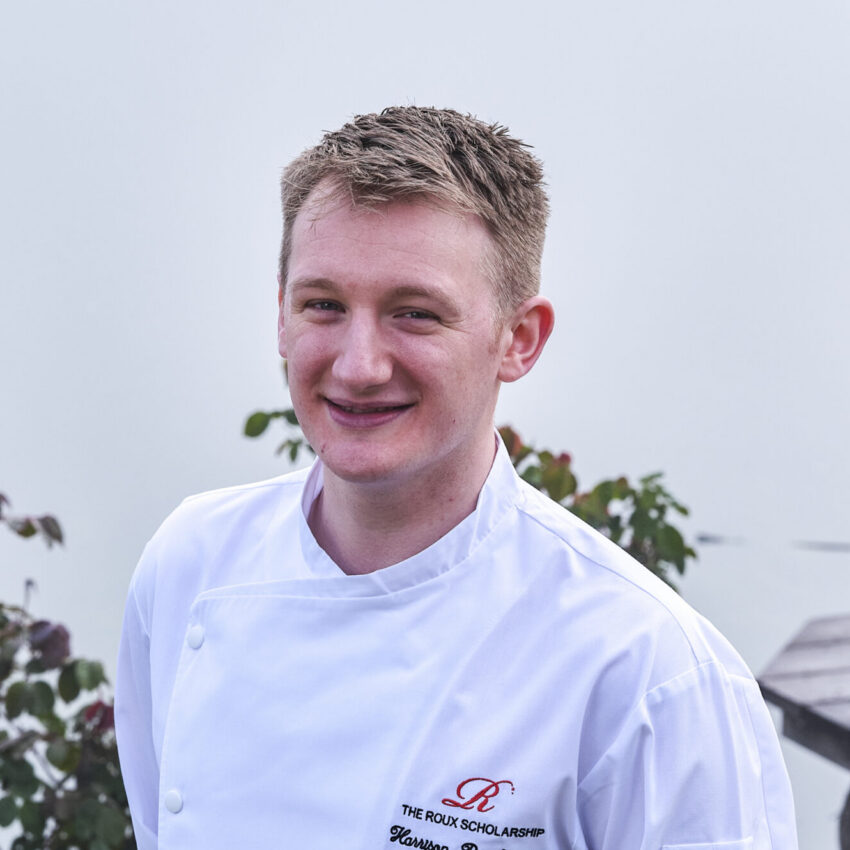
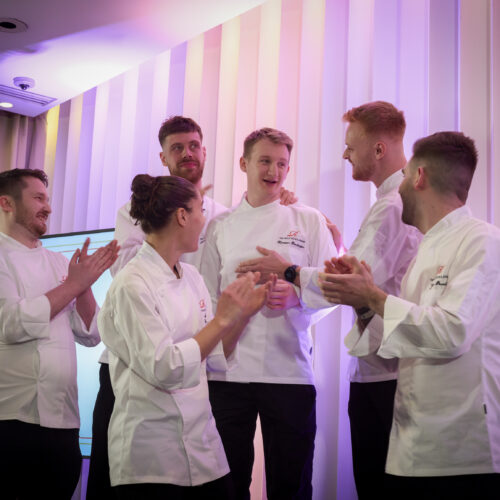
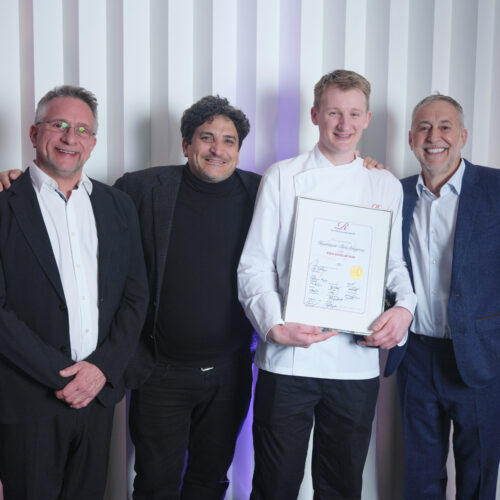
When Honorary President of Judges Mauro Colagreco announced the winner of the Roux Scholarship 2026 on stage at the award ceremony at Coworth Park, an expression of complete disbelief passed across Harrison Brockington's face. He glanced around at the other finalists - among them chefs from one- and two-Michelin starred kitchens - to check he'd heard his name correctly. Speaking afterwards, he admitted he had barely let himself imagine winning, and that he had just taken part to see how far he could get, and to learn more. However, the beauty of The Roux Scholarship is that it is judged by whichever chef makes the best dish on the day.
During a thrilling day at the Alain Roux Culinary School at The Waterside Inn, Bray, Harrison's dish was the one the judges kept returning to. The brief was to create a dish inspired by the cuisine of Mauro Colagreco: a Mediterranean-inspired surf and turf. Harrison responded to the task with a dish that comprised: roasted Dover sole, a cuttlefish stuffed with pork mince, asparagus with Menton lemons, and herbs picked from the garden at the Culinary School. The decision to roast rather than steam the sole was noted by the judges as a mark of confidence, an extra layer of flavour that set the dish apart. The judges' verdict was unanimous.
Harrison is head chef and owner of Gather, a small restaurant in Totnes, Devon, where the menu changes every month and is built around foraged ingredients and local produce. He trained at the Michael Caines Academy at Exeter College, where industry visits, chef demonstrations and a network of southwest producers shaped his approach from the outset. Among his formative experiences was working under Chef John Burton-Race; first at The Grosvenor Hotel in Torquay, then at The Millbrook Inn near Salcombe where, for a period, the two of them ran the kitchen alone and Harrison had the chance to learn much about classic techniques and French ingredients from Chef Burton-Race.
He also learned much about running a business, so when the two parted ways, it felt natural to him to open his own restaurant with friends in 2019 aged just 21.
Harrison competed as a National Finalist in The Roux Scholarship 2024. In 2025, his recipe wasn't selected in the blind-judged application process and, for 2026, he proved he had what it took to win. It showed that chefs from any background and establishment stand a chance at winning.
What did you cook in the final?
The brief was a Mediterranean-inspired surf and turf. I felt fairly lucky as I'd been doing my research before the final, had a look at the season and at Chef Mauro as the Honorary Judge, and I thought Mediterranean flavours were quite likely to come up, so I'd been practising some of those combinations. I'd worked a lot of those flavours with John Burton-Race too, so it felt like familiar territory. The main thing I had to work out was how to get the pork mince into the dish in a way that felt integrated. I'd thought about stuffing the sausage meat into the sole, but I couldn't see how the timing would work; by the time the meat was cooked, the fish would be overdone. So I stuffed it into the cuttlefish instead, so it was connected to the dish. I roasted the Dover sole rather than steaming it, because that felt like the right thing for the flavour; I wanted another layer to it.
How did you prepare for the brief?
You can't know what you're going to be given, but I think you can have a look at the season and the Honorary Judge and make some educated decisions and practise around that. I was lucky enough that those things came up. The written entry [for the application] is actually really hard because you're trying to make it all sound interesting enough on paper, but still give yourself time to do the dessert and make it stand out. And because it's completely blind-judged, it's hard to know what they're looking for. I'd checked it so many times before I submitted it and was still panicking going ‘Are my costings okay? Are there any spelling mistakes?’.
You've entered the Roux Scholarship three times, what kept you coming back?
In 2024 I got through to the final, which was incredible, but I wasn't as happy with what I put on the plate as I'd hoped to be. I'd written a dish I was happy with and then panicked and changed the sauce at the last minute — I did an oyster hollandaise I'd never actually done before. The final is probably not the moment to experiment with something you haven't practised! Then in 2025, I didn't get through the written stage, which was frustrating, but even that was useful for learning. The briefs are really good because there's always something unexpected in there, which keeps you thinking. That's just useful experience regardless of the result. When you're running your own kitchen with no one above you, competitions are one of the best ways to keep developing. You get feedback, you push yourself to practise things you wouldn't otherwise try, and you're learning from the other competitors as much as from the judges. It's not really about the ego of winning.
You opened Gather at just 21 years old. How has running your own kitchen shaped the way you cook?
It was more that I was almost stupid enough to do it than confident. I'd always wanted a restaurant, even walking to school I was drawing up plans, trying to get friends interested. When it came to it, I just thought: ‘Let's go for it’. We change the menu every month, which is probably to our detriment consistency-wise, but it's been really good for learning. And for our regulars it keeps them coming back; we have guests who come every single month to try whatever's new, and in quieter times those loyal customers are what keep us going. If we only changed four times a year with the seasons, it would be harder to encourage people back as often. There are times when the menu changes and we haven't had quite enough time to fully practise a dish, and the first week you're thinking: 'How do we make this work better?' But for learning, for keeping us on our toes, it's been really good.
Who has been the biggest influence on your cooking?
In my last year at college John Burton-Race moved back to the area and came in to speak to students. Then I went to work with him at The Grosvenor and he was always there in the kitchen, cooking alongside you and teaching, so there was quite a lot of one-on-one time with him. And then when the restaurant went into administration, he asked me to come with him to The Millbrook. At that point it was literally just the two of us in the kitchen. Cooking next to him every day, hearing the stories, learning how to make things, was pretty extraordinary. The foundation was French classics with a lot of influence from the Hotel Meurice as well, where he'd been head chef for a long time. The base knowledge I got, both the cooking and the way he ran things, was really, really valuable. He phones occasionally and last time I was in the finals I rang him for a bit of advice.
What advice would you give to future applicants?
Just the act of applying and committing to the practice is valuable. You learn from the process as much as the result; even if you don't get through, you're coming in at weekends, practising, thinking through the brief, pushing yourself to try things you wouldn't otherwise attempt. When you get to the final, do your research beforehand: have a look at the season and the Honorary Judge and make some educated decisions about what might come up. And cook what you know. The finals are probably not the moment to experiment with something you haven't practised.
What are your ambitions for the scholarship year ahead?
I want to find places to stage where they'll actually teach you, rather than somewhere you just slot into a role doing what you already know. I want to think carefully about what would actually push me forward rather than just going to places with famous names. I'm really interested in the farm-to-plate side of things, Chef Mauro's garden at Le Mirazur is amazing and that's the kind of thing I want to explore more. The Scholarship is a chance to seek out experiences I couldn't otherwise access.